Articles
Eskom Green: opportunity, transmission risk, and the case for independent grid governance
25/06/2026
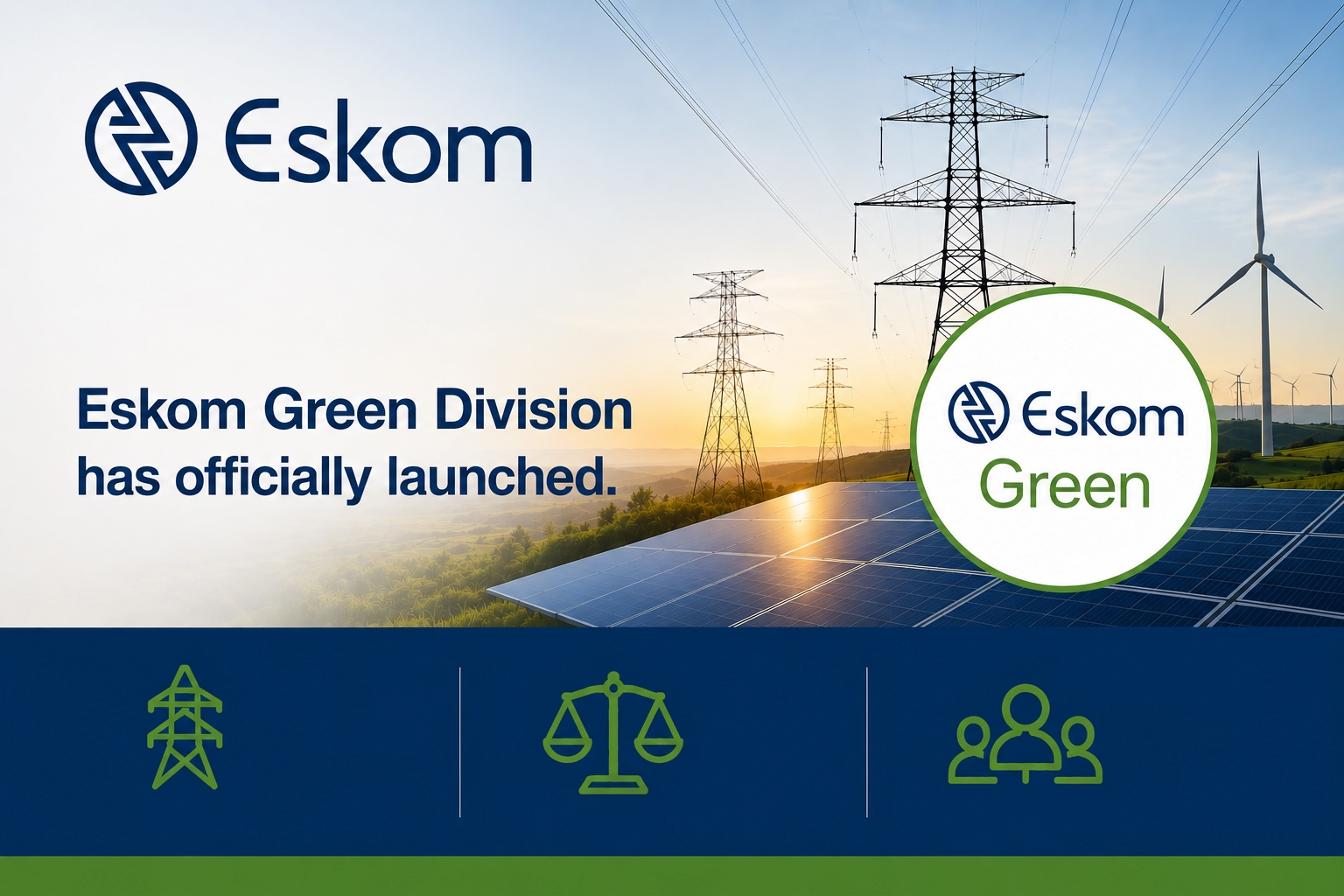
Eskom’s newly launched Green Division — marks a significant shift in how South Africa’s state utility intends to participate in the renewable energy sector. For independent power producers, funders, developers, and the businesses that depend on a functioning grid, this development raises questions that deserve careful, clear-eyed examination.
At Enerthia Energy, our work spans Energy Consultancy, Business Development, Product & Service Endorsement, and Funding Origination. Across all four offerings, grid access and market structure sit at the centre of every project we originate and every client conversation we have. What Eskom Green represents — both the opportunity and the risk — is directly relevant to every stakeholder we serve.
What Eskom Green actually is, and where transmission risk sits
Eskom Green is a dedicated renewable energy and battery storage division established within the state utility with a mandate to develop utility-scale projects in partnership with private sector developers, financiers, and technology providers. Its stated aim is to accelerate generation capacity, support South Africa’s decarbonisation objectives, and attract long-term energy investment. On paper, this is a constructive development. South Africa needs generation capacity at scale, and a focused vehicle within Eskom — one designed to engage the private sector rather than exclude it — could, in principle, accelerate deployment.
The South African Photovoltaic Industry Association (SAPVIA) has welcomed the launch while issuing a measured caution: equitable access to the limited transmission grid must be assured for all independent power producers, not only for Eskom Green’s own pipeline. That caution is well founded, and it deserves wider attention than it has so far received.
The transmission monopoly problem
South Africa’s transmission infrastructure is owned and operated by Eskom. The grid is constrained — interconnection queues are long, available capacity in key generation corridors is limited, and expansion has lagged behind both demand growth and the volume of renewable projects seeking connection. This is not a new problem, but the creation of Eskom Green sharpens it considerably.
When the entity that owns the wires also competes for generation capacity on those same wires, a structural conflict of interest arises. Eskom Green will originate, develop, and finance its own renewable projects. It will simultaneously — through its transmission function — influence which projects gain grid access, at what cost, and on what timeline. Even where no deliberate preference is shown, the incentive structure creates a risk that independent power producers find themselves at a disadvantage when competing with a state utility for the same constrained grid capacity. In competitive markets globally, this is precisely why transmission and generation are separated, either structurally or through an independent system operator with a clear, enforceable mandate of neutrality.
Why an independent transmission body is not optional
South Africa has long debated the establishment of a fully independent transmission system operator. The conversation has accelerated under the Electricity Regulation Amendment Act, but implementation has been slow. The launch of Eskom Green makes the urgency of this structural reform far more concrete. Without an independent body assigned to manage transmission line access — one with no stake in who generates the power that flows across those lines — the renewable energy sector faces a market structure where the referee also plays in the match.
The consequences extend beyond IPPs. Commercial and industrial offtakers, agricultural businesses, municipalities, and any entity that has invested in or is planning a behind-the-meter or wheeling-based renewable solution needs confidence that the grid will be managed in the public interest, not in the interest of any single generator — state-owned or otherwise. Businesses considering power purchase agreements with terms of five to twenty-five years cannot absorb the regulatory and access uncertainty that an ungoverned conflict of interest introduces.
What this means for project funding and origination
From a funding origination perspective, transmission access uncertainty is a bankability issue. Funders and investors — including the panel of 32 funders and investors through which Enerthia originates project funding up to R500 million — assess grid connection risk as a material factor in project viability. Where connection timelines are unpredictable, or where access is perceived to favour a state-owned competitor, the risk premium applied to IPP projects rises, and some transactions that should be fundable become difficult to place. South Africa cannot afford that outcome at a moment when the country needs every viable renewable megawatt it can bring online.
Transparent, rules-based grid access allocation — administered by a body with no generational interest — is not a regulatory nicety. It is the condition under which private capital continues to flow into South Africa’s energy transition.
A constructive path forward
None of this is an argument against Eskom Green’s existence. A focused renewable energy vehicle within Eskom, properly governed and genuinely open to private sector partnership, could be a net positive for South Africa’s energy future. SAPVIA’s own position reflects this: welcome the initiative, hold it to account on access. That is the right instinct.
What is needed in parallel is an accelerated commitment to independent transmission governance. Policy certainty, efficient regulatory processes, and transparent grid access allocation are not conditions that the market can produce on its own. They require structural decisions at government and regulatory level. The sooner those decisions are made, the sooner Eskom Green, South Africa’s IPP sector, and the businesses that depend on reliable, affordable energy can all operate from a foundation that is genuinely stable.
Enerthia Energy will continue to monitor this space closely. Clients and partners with questions about how evolving grid policy affects their projects or funding structures are welcome to engage us directly through our no-fee Energy Consultancy — the starting point for any conversation about renewable energy strategy, project structuring, or funding origination across South Africa and the broader African market.
Contact Vanessa Mann on WhatsApp at +27 82 899 6078, or reach us at info@enerthiaenergy.co.za · enerthiaenergy.co.za
Enduring energy — built to last.