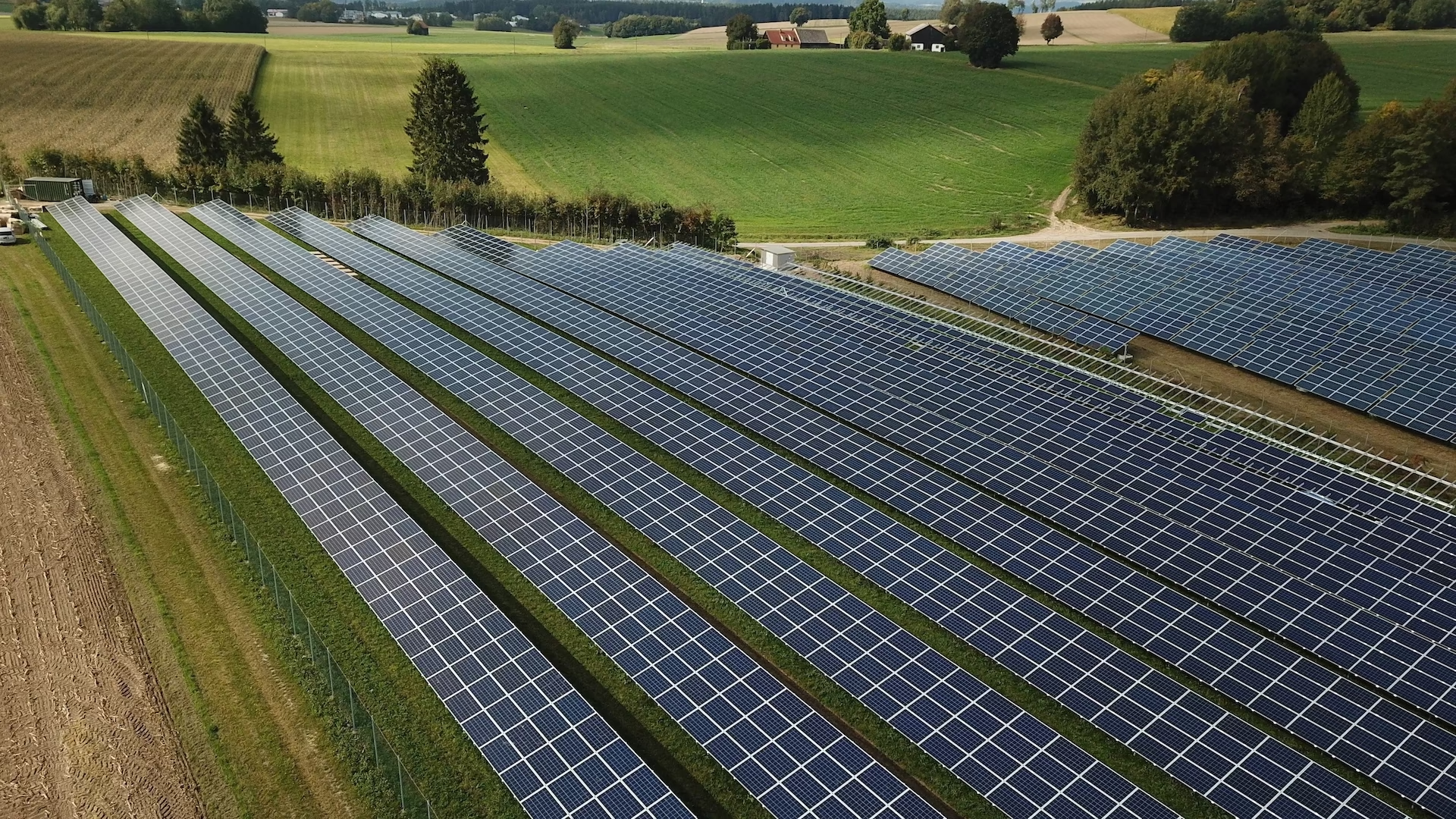
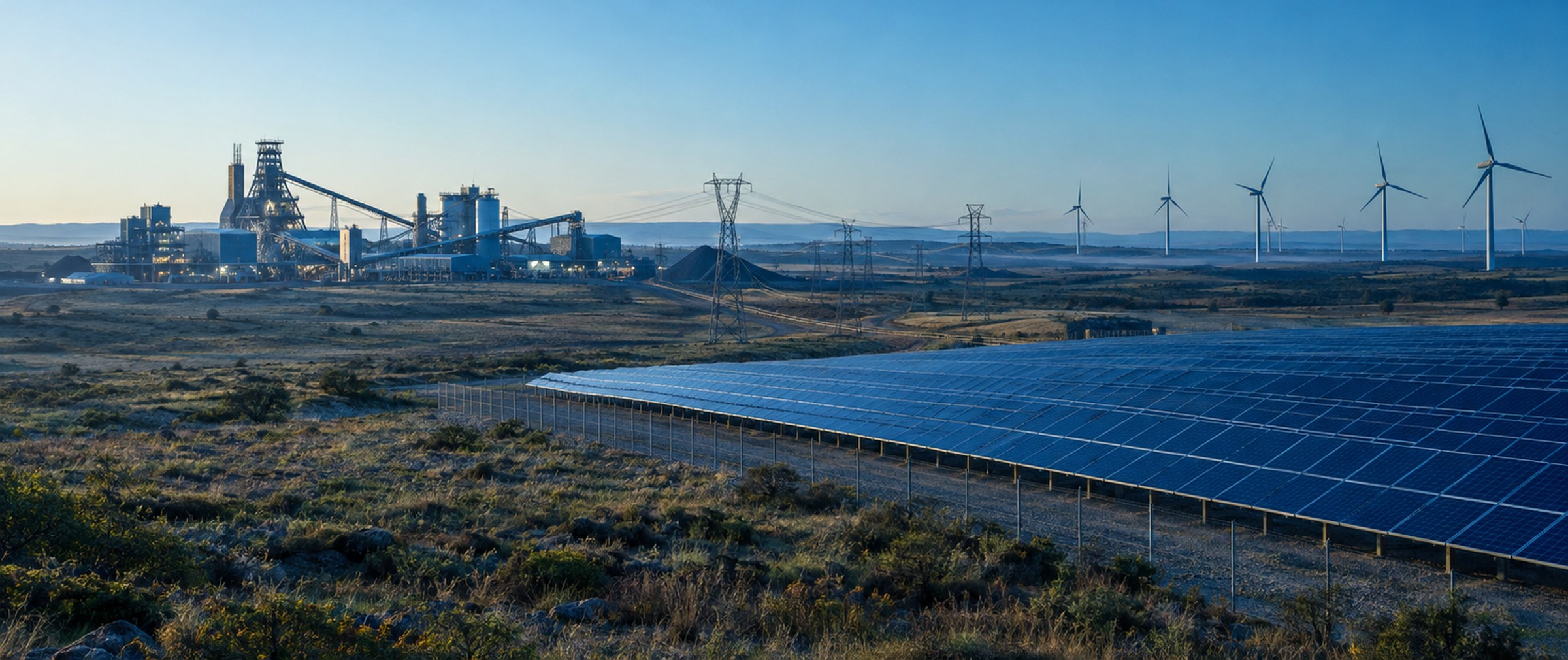
Enerthia Energy works across four offerings — energy consultancy, business development, product and service endorsement, and funding — and this year one shift runs through all four: the corporate PPA South Africa market is no longer the alternative route to a renewable energy project, it is the main one. In the first half of 2026, seventeen independent power producer projects reached commercial operation, and ten of them sold their output straight to mining and industrial buyers rather than into a public procurement round. The counterparty has changed, and with it the shape of the deal.
- 17 IPP projects totalling 1 920 MW reached commercial operation in the first half of 2026 — the largest half-year addition on record.
- 10 of those projects, 1 046 MW, supplied mining and industrial buyers directly; the other seven, 874 MW, came through government programmes.
- The previous full-year record was 1 472 MW, set in 2016.
- A further 28 projects, 2 202 MW, are due in the second half, for a projected 4 123 MW across the year.
Prefer to listen on YouTube? The episode is below, and on the Enerthia Energy channel in the Podcasts Insights playlist.
Who is buying South Africa’s new generation capacity now?
Private companies are. Of the seventeen projects that reached commercial operation between January and June 2026, ten were privately procured and supply mining houses and industrial users directly, with a combined 1 046 MW. The remaining seven, 874 MW, came through Bid Windows 5 and 6 of the Renewable Energy Independent Power Producer Procurement Programme and the Risk Mitigation programme. Wind carried much of the volume, with seven wind farms adding 815 MW. Research from the Power Futures Lab at the University of Cape Town Graduate School of Business puts the half-year total at 1 920 MW, the highest capacity added in any half-year period.
What does a corporate PPA South Africa deal change about credit?
It moves the credit question from a programme to a single company. Under a public round the offtake sits behind standardised documentation and programme-level support, so much of the diligence is about compliance with that framework. A private offtaker is assessed on its own terms instead: its financial position, its sector cycle, its customer concentration, and how its revenue behaves in a downturn. Lenders price that counterparty directly rather than pricing a procurement round, which is why developers are increasingly building a portfolio of buyers rather than relying on one. The same logic runs through the capital stack, where the mix of funders behind this year’s closes has shifted alongside the mix of buyers.
How does a private buyer change tenor, sizing and security?
It shortens and individualises all three. A public round sets a twenty-year term; a corporate buyer contracts against its own planning horizon, licence period or mine life, and a shorter, less certain tenor changes both debt sizing and the equity return profile. The plant is sized to one user’s load profile rather than to a grid-wide need, so the route the electrons take — direct connection, wheeled to a site elsewhere on the grid, or traded — becomes part of the commercial design rather than an afterthought. Without programme guarantees, the parties negotiate their own security package: parent support, credit enhancement, termination provisions and step-in rights.
What should a developer, funder or energy user do differently?
Start with the buyer rather than the site. For a large energy user, this is the moment the market comes to them: a creditworthy load is now the scarce input, which is standing to negotiate rather than accept a standard offer. For a developer, the work moves upstream into origination and credit, because the valuable thing is a matched pair — a buyer whose load suits an asset, and a funder comfortable with that specific counterparty. Timing belongs in the plan too. Financial close activity slowed through the middle of 2026, with only the Hartebeesfontein battery project closing in the second quarter, which researchers attribute to grid-connection approvals and commercial clearances rather than to weaker investor appetite.
A further 28 projects representing 2 202 MW are scheduled for the second half of 2026, which would take the year to 4 123 MW. The projects that reach commercial operation in 2028 are being originated now, around buyers who do not yet know they are the counterparty — which is where our business development work begins.