Enerthia Energy works across Energy Consultancy, Business Development, Product & Service Endorsement and Funding, and one question is reaching us from South African property owners more often than any other this year: what happens once the roof is full? Rooftop solar has passed 8.3 GW nationally, the largest listed landlords are running out of roof space, and electricity wheeling in South Africa is what the next increment of clean power now looks like.
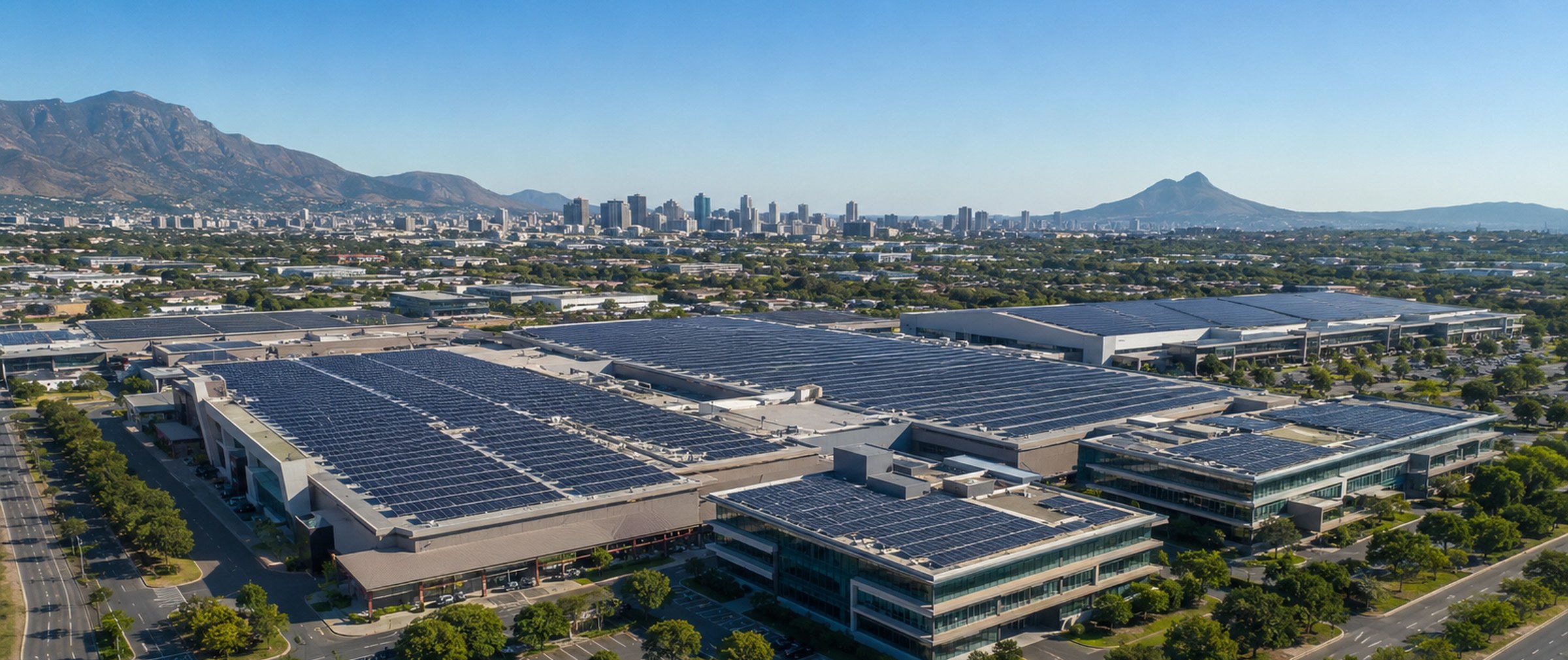
- South Africa’s installed rooftop solar has passed 8.3 GW, most of it on shopping centres, warehouses, farms and office parks, and more than the operational solar contracted under the state procurement programmes combined at about 2.8 GW.
- Redefine Properties, the country’s second-largest listed landlord, is running out of rooftop space and is exploring other ways to deploy solar.
- Growthpoint, Etana Energy and the City of Cape Town completed South Africa’s first pooled wheeling allocation in April 2026, across five buildings, with a stated plan for more than 30 Cape Town properties.
- By April 2026 Nersa had registered close to 19.6 GW of private generation capacity, most of it aimed at private buyers across the grid rather than a single meter.
What happens when a landlord runs out of roof space?
The cheap electricity does not stop, but the way you buy it changes completely. Up to that point solar is a procurement exercise: size the array to the daytime load, sign, and watch the bill fall. In May 2026 it was reported that Redefine Properties, South Africa’s second-largest listed property group, had run out of rooftop space for further installations and was looking at other ways to deploy solar. That is not a funding problem and not a technology problem. The panels work and the appetite is there — as we set out when private solar overtook the grid’s own renewable fleet. The roof simply ran out, and the next megawatt has to come from somewhere else on the grid.
How does electricity wheeling in South Africa actually work?
Wheeling moves electricity from a generator somewhere else in the country, across the Eskom and municipal networks, to a building that agrees to buy it. Growthpoint installed its first rooftop plant in 2011 and has since put more than R1 billion into solar. In November 2023 it signed a power purchase agreement with the licensed trader Etana Energy for 195 GWh a year, roughly 32 per cent of its total electricity consumption, structured as the country’s first multi-jurisdiction, multi-building, multi-source wheeling arrangement. The generation sits far from the tenant; the contract, the metering and the municipal framework are what connect them, and there are two doors into a wheeling deal.
Why does pooled wheeling change the arithmetic for a portfolio?
Because it moves the unit of negotiation from the building to the fund. In 2026 Growthpoint, Etana Energy and the City of Cape Town completed the first pooled wheeling of renewable electricity across multiple properties inside one municipal network, with the first allocation settled in April 2026. Power generated at the Boston hydroelectric plant in the Free State is wheeled across the Eskom network into the City’s grid and allocated across a pool of buildings. Five participate today, including the refurbished 36 Hans Strijdom, which now draws all of its grid electricity through the pooled allocation. More than 30 Cape Town properties are planned. Matching supply and demand across a portfolio, rather than site by site, is what makes the structuring effort worth funding.
What should a property owner decide first?
Start with grid position, then aggregation, then the contract. A building inside a municipal network sits under a different framework to one connected directly to Eskom, and municipal frameworks differ from each other. A single property rarely justifies the structuring effort, while a portfolio usually does. A power purchase agreement runs for years, so trader credentials, generation mix, curtailment exposure, escalation and settlement mechanics all matter. Metering, billing and the lease have to carry the wheeled electricity through to the tenant. And timing is real: the Cape Town pilot took more than eighteen months of collaboration between the landlord, the trader and the municipality.
The pipeline says the generation is coming. By April 2026 Nersa had registered close to 19.6 GW of private capacity, with 132 new projects totalling 1.34 GW registered in the first four months of the year alone. The question is no longer whether clean electricity is available — it is whether a portfolio is structured to receive it. Electricity wheeling in South Africa is now a portfolio-design decision, not a rooftop decision. That is where our energy consultancy work begins. The roofs filling up is not the end of the story; it is the point at which cheap electricity stops being a purchase and starts being a structure.
Visit our Resources page for our offerings profiles: