Enerthia Energy works across four connected offerings — energy consultancy, business development, product and service endorsement, and funding. This briefing sits squarely in the first: what South Africa’s privately owned solar fleet has become, and why most businesses are still sizing it for the wrong problem.
Private solar is bigger than the programme
South Africa’s privately owned rooftop and embedded solar capacity has passed 8.3 GW. That figure comes from the National Transmission Company of South Africa and was reported in June 2026. It is not a forecast or an industry estimate — it is the operator of the national grid describing what is already installed and running.
For scale: rooftop solar alone now exceeds the total operational solar capacity contracted under the country’s flagship public procurement programmes, REIPPPP and the Risk Mitigation programme, which together sit at roughly 2.8 GW operational. The crossover happened earlier still. By September 2025 the transmission company put private rooftop capacity at 7 345 MW against 7 172 MW of renewable generation bought from independent power producers — private capacity having grown 23% in a single year. Nationally, total installed solar has now passed 10 GW, roughly 1.6 GW of it added last year, making South Africa the largest solar market on the continent.
Most of it is not on houses
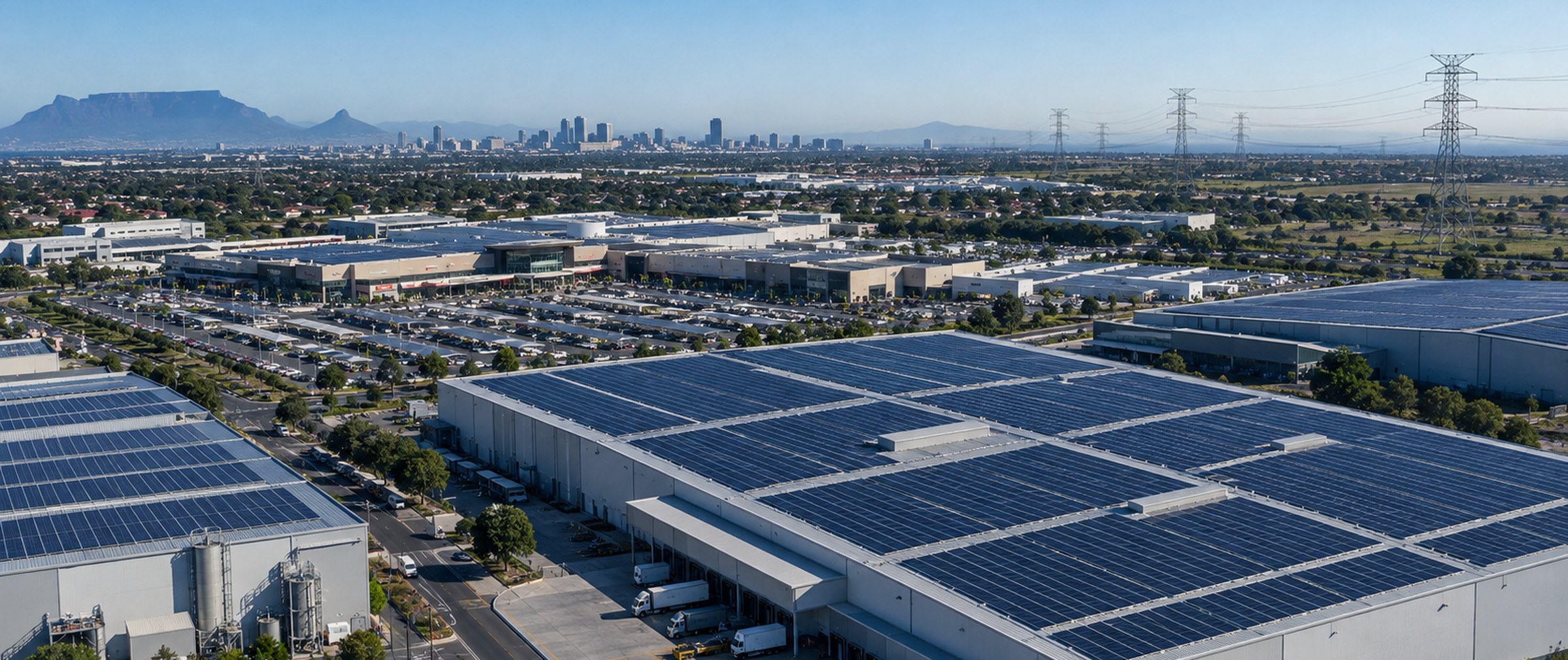
The bulk of that 8.3 GW sits on shopping centres, distribution warehouses, farms and light-industrial roofs. Households are a smaller share than most people assume: Statistics South Africa counted 675 000 homes with solar panels in 2025, an 86% increase in three years, more than two-thirds of them in Gauteng and the Western Cape. Commercial and industrial uptake is what moved the national number.
There is a caveat worth understanding. The transmission company measures this using the residual load method — comparing grid demand on sunny days against cloudy days and inferring what sits behind the meter. It cannot see individual installations and cannot separate a household’s 5 kW system from a distribution centre’s 3 MW roof. The figure is an inference rather than a register, and it is almost certainly conservative.
The reason people buy has changed
Load shedding effectively ended in early 2024 and installations kept climbing anyway. The driver now is tariffs. Successive above-inflation increases have made self-generated electricity cheaper than grid electricity for a large share of commercial users. That turns solar from an insurance policy into a procurement decision with a return profile — and those are different questions.
A generator replacement asks how long you can keep the lights on. A procurement decision asks what share of annual consumption can realistically be displaced, what the load profile looks like at four in the afternoon when output falls away, whether storage or a wheeled supply covers the gap, how the asset is owned and financed, and what happens to that arrangement if the site is sold or the lease ends. Those are balance sheet questions, not installer questions.
The utility is now competing for the same customer
Because most private systems carry no storage, output collapses at sunset exactly as evening demand rises, forcing a steep and expensive ramp from conventional plant every day. That daily manoeuvre is part of why connection rules and tariff structures are being rewritten around distributed generation rather than against it. Registration for small-scale systems up to 50 kVA has been eased, with the connection fee waiver extended and a smart meter provided at no charge.
More significantly, the utility is standing up a separate renewable energy business and has launched an offtake programme aimed at retaining large commercial customers by selling them low-carbon supply rather than watching them build their own. So a large energy user now has several routes: self-generate, buy a wheeled supply, contract with the utility’s renewable arm, or combine them. Each carries a different capital structure, risk allocation and set of counterparties.
The practical failure at this point is not scepticism. It is sizing. Specified like a generator — match the peak, cover the outage, move on — a rooftop array is a resilience asset that happens to save some money. Specified against a real load profile and a real tariff forecast, with storage and wheeling considered as options rather than afterthoughts, it becomes a supply strategy with a measurable effect on unit cost.
8.3 GW is what happens when a market makes that decision one site at a time. The question is no longer whether private generation works. It is whether the version on your roof was designed for the problem you actually have.
Decks and further reading: enerthiaenergy.co.za/resources