Category: Articles

Enerthia articles and perspectives.

  • Beyond Megawatts: Why Grid, Storage and Capital Now Decide South Africa’s Energy Transition

    Beyond Megawatts: Why Grid, Storage and Capital Now Decide South Africa’s Energy Transition

    Articles

    Beyond Megawatts: Why Grid, Storage and Capital Now Decide South Africa’s Energy Transition

    10/07/2026

    South Africa’s renewable energy programme has moved past the question of whether renewables work. Over seven bid windows, the REIPPPP has procured more than 7 GW of capacity and mobilised over R240-billion in private investment — one of the developing world’s most credible public-private procurement track records.

    Watch the vlog

    Bid Window 7 confirmed both the appetite and the constraint. Government sought 5 000 MW; the market responded with 10.2 GW of bids. Eight solar projects totalling 1 760 MW were appointed as preferred bidders, representing R31.4-billion in investment, with further projects added on value-for-money grounds. Demand for well-structured renewable projects far exceeds what the system can currently absorb.

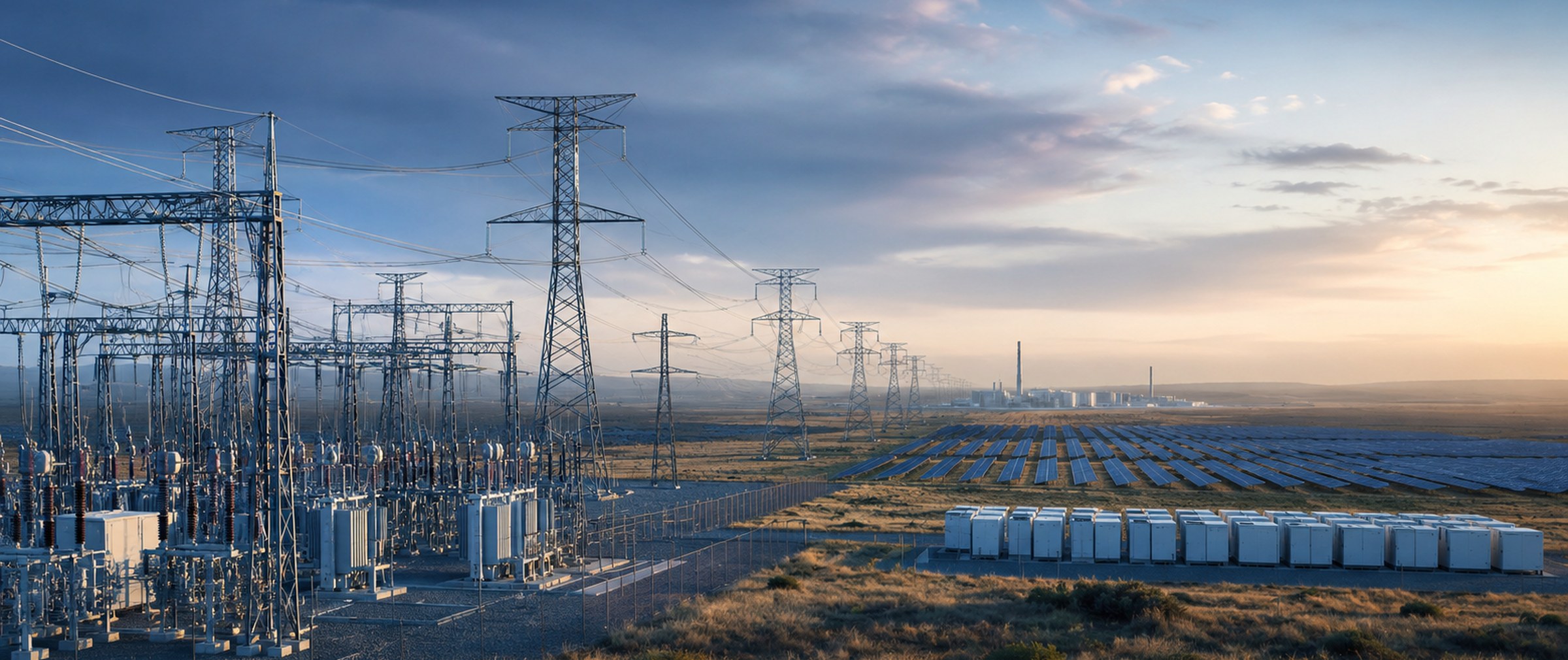
    The grid is now the binding constraint on the energy transition

    The binding constraint is no longer generation — it is the grid. Thousands of kilometres of new transmission lines are needed over the next decade to unlock the capacity the economy demands. Government has responded: in December 2025, seven consortia were prequalified for the first R17-billion, 1 064 km phase of the Independent Transmission Projects programme — opening private capital participation in transmission for the first time.

    Battery storage is following the same trajectory, with dedicated procurement rounds now running alongside generation. The future system will be won on integration: generation, storage, transmission and flexibility working as one.

    What winning projects now require

    This shifts what success requires. Winning projects now demand credible local development partners, experienced technical teams, and — above all — funding structures matched to increasingly complex infrastructure. Commercial banks, DFIs, pension funds and international investors are all active, but connecting the right capital to the right project at the right stage has become the decisive skill.

    That is where Enerthia Energy operates. As a funding originator and energy consultancy, we connect bankable energy projects with the capital and partnerships they need — supported by our product and service endorsement and business development offerings. We don’t fund from our own balance sheet and we don’t build; we originate, structure and enable.

    The first decade of the REIPPPP proved renewables work. The next decade will be decided by grid capacity, integrated systems and the quality of the partnerships behind each project. The opportunity is real — and it belongs to those positioned to deliver.

    Enerthia Energy — Energy Consultancy | Business Development | Product & Service Endorsement | Funding Origination.

  • Eskom Green

    Eskom Green

    Articles

    Eskom Green: opportunity, transmission risk, and the case for independent grid governance

    25/06/2026

    Eskom’s newly launched Green Division — marks a significant shift in how South Africa’s state utility intends to participate in the renewable energy sector. For independent power producers, funders, developers, and the businesses that depend on a functioning grid, this development raises questions that deserve careful, clear-eyed examination.

    At Enerthia Energy, our work spans Energy Consultancy, Business Development, Product & Service Endorsement, and Funding Origination. Across all four offerings, grid access and market structure sit at the centre of every project we originate and every client conversation we have. What Eskom Green represents — both the opportunity and the risk — is directly relevant to every stakeholder we serve.

    What Eskom Green actually is, and where transmission risk sits

    Eskom Green is a dedicated renewable energy and battery storage division established within the state utility with a mandate to develop utility-scale projects in partnership with private sector developers, financiers, and technology providers. Its stated aim is to accelerate generation capacity, support South Africa’s decarbonisation objectives, and attract long-term energy investment. On paper, this is a constructive development. South Africa needs generation capacity at scale, and a focused vehicle within Eskom — one designed to engage the private sector rather than exclude it — could, in principle, accelerate deployment.

    The South African Photovoltaic Industry Association (SAPVIA) has welcomed the launch while issuing a measured caution: equitable access to the limited transmission grid must be assured for all independent power producers, not only for Eskom Green’s own pipeline. That caution is well founded, and it deserves wider attention than it has so far received.

    The transmission monopoly problem

    South Africa’s transmission infrastructure is owned and operated by Eskom. The grid is constrained — interconnection queues are long, available capacity in key generation corridors is limited, and expansion has lagged behind both demand growth and the volume of renewable projects seeking connection. This is not a new problem, but the creation of Eskom Green sharpens it considerably.

    When the entity that owns the wires also competes for generation capacity on those same wires, a structural conflict of interest arises. Eskom Green will originate, develop, and finance its own renewable projects. It will simultaneously — through its transmission function — influence which projects gain grid access, at what cost, and on what timeline. Even where no deliberate preference is shown, the incentive structure creates a risk that independent power producers find themselves at a disadvantage when competing with a state utility for the same constrained grid capacity. In competitive markets globally, this is precisely why transmission and generation are separated, either structurally or through an independent system operator with a clear, enforceable mandate of neutrality.

    Why an independent transmission body is not optional

    South Africa has long debated the establishment of a fully independent transmission system operator. The conversation has accelerated under the Electricity Regulation Amendment Act, but implementation has been slow. The launch of Eskom Green makes the urgency of this structural reform far more concrete. Without an independent body assigned to manage transmission line access — one with no stake in who generates the power that flows across those lines — the renewable energy sector faces a market structure where the referee also plays in the match.

    The consequences extend beyond IPPs. Commercial and industrial offtakers, agricultural businesses, municipalities, and any entity that has invested in or is planning a behind-the-meter or wheeling-based renewable solution needs confidence that the grid will be managed in the public interest, not in the interest of any single generator — state-owned or otherwise. Businesses considering power purchase agreements with terms of five to twenty-five years cannot absorb the regulatory and access uncertainty that an ungoverned conflict of interest introduces.

    What this means for project funding and origination

    From a funding origination perspective, transmission access uncertainty is a bankability issue. Funders and investors — including the panel of 32 funders and investors through which Enerthia originates project funding up to R500 million — assess grid connection risk as a material factor in project viability. Where connection timelines are unpredictable, or where access is perceived to favour a state-owned competitor, the risk premium applied to IPP projects rises, and some transactions that should be fundable become difficult to place. South Africa cannot afford that outcome at a moment when the country needs every viable renewable megawatt it can bring online.

    Transparent, rules-based grid access allocation — administered by a body with no generational interest — is not a regulatory nicety. It is the condition under which private capital continues to flow into South Africa’s energy transition.

    A constructive path forward

    None of this is an argument against Eskom Green’s existence. A focused renewable energy vehicle within Eskom, properly governed and genuinely open to private sector partnership, could be a net positive for South Africa’s energy future. SAPVIA’s own position reflects this: welcome the initiative, hold it to account on access. That is the right instinct.

    What is needed in parallel is an accelerated commitment to independent transmission governance. Policy certainty, efficient regulatory processes, and transparent grid access allocation are not conditions that the market can produce on its own. They require structural decisions at government and regulatory level. The sooner those decisions are made, the sooner Eskom Green, South Africa’s IPP sector, and the businesses that depend on reliable, affordable energy can all operate from a foundation that is genuinely stable.

    Enerthia Energy will continue to monitor this space closely. Clients and partners with questions about how evolving grid policy affects their projects or funding structures are welcome to engage us directly through our no-fee Energy Consultancy — the starting point for any conversation about renewable energy strategy, project structuring, or funding origination across South Africa and the broader African market.

    Contact Vanessa Mann on WhatsApp at +27 82 899 6078, or reach us at info@enerthiaenergy.co.za · enerthiaenergy.co.za

    Enduring energy — built to last.

  • Endorsement Partners programme | Enerthia Energy

    Endorsement Partners programme | Enerthia Energy

    If your renewable energy product or service is genuinely good, the market should know about it — not through cold outreach and trade-show brochures, but through the people who actually specify, finance, and install projects. That is the gap Enerthia’s Endorsement Partners programme fills.

    Enerthia Energy operates across the renewable energy value chain through four co-equal offerings: Energy Consultancy for offtakers, Business Development and Independent Contracting, Product and Service Endorsement, and Funding Origination. Our position at the centre of the conversation between offtakers, EPCs, and funders creates channels that no advertising spend can replicate. Endorsement is how quality products and service providers access those channels.

    What the renewable energy endorsement programme actually is

    Endorsement is a contracted, minimum six-month relationship between Enerthia and a named product line or service provider that has cleared our qualifying bar. It is not a directory listing, a logo on a sponsorship wall, or a vague association. It is structured, sustained promotion across the channels we control — and the reach those channels carry is concrete: a 55-EPC active partner network and a panel of 32 funders and investors, all of whom we educate on the products and providers we endorse.

    Six deliverables define what endorsement means in practice: your product or provider is named in Enerthia’s profile documents; you receive a dedicated presence on enerthiaenergy.co.za with direct links driving qualified EPC and funder traffic; we maintain a sustained social media presence across LinkedIn, Instagram, and Facebook featuring your applications and capability; you are surfaced in our offtaker advisory conversations where the fit is genuine; EPC partners across the network are educated on your capability, support, and warranty terms; and we scope co-branded events — site visits, technical briefings, panel discussions — within the agreement term. By extension, funders on our panel are also educated and may surface endorsed products and providers in their own offtaker conversations.

    Why selectivity is the whole point

    An Enerthia endorsement carries weight precisely because we turn down more than we accept. Endorsement attaches to a named product or service provider — not a brand portfolio — and the qualifying criteria are set deliberately high. For products, we require Tier 1 or SATIA-listed standing, local technical support with warranty execution resident in South Africa, and roadmap alignment with the current market. For service providers, we look for a verifiable track record of C&I delivery at scale, complexity capability across multiple sites and phased rollouts, delivery to deadline, and reference-verified offtaker satisfaction of 9/10 or higher. Both tracks share common requirements: good standing in South Africa, healthy financial standing sufficient to honour warranties and obligations, regulatory and safety compliance, genuine SA market commitment, and reputation alignment.

    Assessment is conducted in writing, with references taken from EPCs, funders, and prior counterparties as appropriate. If a product or provider does not qualify, the engagement closes — no fee, no obligation. That gate is what makes the mark mean something to the EPCs and funders who see it.

    The integrity boundaries that protect the value

    Endorsement does not buy automatic specification. Where a project genuinely fits a non-endorsed product better, the right product is specified — engineering fit comes first. Enerthia’s offtaker consultancy carries a no-oversizing pledge, and endorsement is not a vehicle for selling more than a project needs. We do not conceal alternatives, and we do not direct EPCs to specify endorsed products against their own technical judgement. EPCs are educated and trusted. The relationship is a contracted, disclosed, paid arrangement — visible in the agreement, visible in the deliverables, visible to anyone who asks. The integrity boundary is the commercial value.

    How the commercial framework works

    The endorsement agreement sets a minimum six-month term, with a monthly fee payable in advance, specific to the named product line or service provider — not a brand portfolio. Additional product lines or providers fall under separate scope. Performance, deliverables, and commercial fit are reviewed jointly at each renewal point, and either party may decline renewal without cause. Indicative fee ranges are shared on request once the qualifying criteria are met.

    The full sequence from mutual NDA through qualification, agreement, onboarding, and channel activation typically completes within three to five weeks for a well-prepared partner. Onboarding covers positioning, talking points, target applications, restricted claims, asset standards, and the first-quarter content schedule. From activation, the content cycle runs continuously — website presence live, social cycle underway, EPC partner briefings scheduled — with a quarterly endorsement report covering channel reach, EPC engagement, funder engagement, and project conversations.

    Who should be talking to us

    If you manufacture or distribute a renewable energy product that meets Tier 1 standards and has genuine SA market commitment, or if you are an EPC or service provider with a verifiable track record in C&I delivery and offtaker satisfaction you can put your name to — and if consistent, structured visibility across 55 EPCs and 32 funders is the kind of exposure your business should have — then this conversation is worth starting.

    Reach out to Vanessa Mann directly: WhatsApp +27 82 899 6078, or email info@enerthiaenergy.co.za. If you would like to understand the qualifying criteria before making contact, that conversation carries no obligation on either side. The first step is simply a mutual NDA — then we work through the criteria together, in writing, and see whether the fit is there.

    Enduring energy — built to last.

  • Solar panel and battery prices set to skyrocket — why acting now matters

    Solar panel and battery prices set to skyrocket — why acting now matters

    Solar panel and battery prices have trended downward for over a decade. That era is ending. A confluence of new trade tariffs, supply-chain realignments, and rising raw-material costs is pushing equipment prices upward — and for South African businesses and agricultural operations planning a renewable energy transition, the window to lock in current pricing is narrowing faster than most realise.

    Acting now is not a sales pitch. It is a practical observation grounded in what is happening in global energy markets. Enerthia Energy (Pty) Ltd works across the renewable energy value chain through four offerings — Energy Consultancy, Business Development, Product & Service Endorsement, and Funding Origination — and what we are seeing across our project pipeline confirms the trend: procurement decisions delayed by six to twelve months are increasingly costing clients materially more than the same project would have cost had it moved forward earlier.

    What is driving solar panel and battery prices

    The primary pressure points are well-documented. United States tariff policy has triggered retaliatory and defensive trade responses globally, disrupting the low-cost panel supply chains that kept residential and commercial solar affordable for the better part of ten years. Simultaneously, lithium, cobalt, and other battery-chemistry inputs face supply constraints and increased demand from both the energy storage and electric vehicle sectors. Freight and logistics costs, while eased from their pandemic-era peaks, have not returned to pre-2020 norms. For South Africa specifically, rand volatility amplifies every dollar-denominated movement in equipment pricing.

    These are not temporary fluctuations. Analysts across the sector broadly expect the cost trajectory for panels and battery storage to remain elevated through the medium term, with meaningful relief unlikely before 2027 at the earliest — and even that projection carries significant uncertainty.

    Why energy consultancy is the right first step

    Enerthia’s Energy Consultancy offering exists precisely for this kind of inflection point. It is a no-fee advisory entry point for offtakers — businesses, farms, food processors, and industrial operations — who need an honest, structured assessment of their energy position before committing to any procurement or funding path. There is no obligation to proceed, no product being sold, and no installer being favoured. The consultancy function is about giving decision-makers a clear picture: current consumption profile, realistic system sizing, indicative capital cost at today’s pricing versus projected pricing in twelve months, and the most appropriate financing structure for their circumstances.

    In a rising-price environment, that clarity has direct commercial value. A farm operation that understands today that a R8 million solar and storage system will likely cost R9.5 million in eighteen months is in a fundamentally different negotiating and planning position than one that defers the analysis indefinitely. The consultancy conversation costs nothing and creates the information needed to act rationally.

    Funding origination: moving from decision to execution

    Once an offtaker has a clear system specification and a credible EPC contractor engaged, the next constraint is almost always capital. This is where Enerthia’s Funding Origination capability becomes the material difference between a project that moves and one that stalls. Enerthia originates, structures, and places project funding — it does not lend from its own balance sheet, but it works across a panel of 32 funders and investors and holds direct relationships with South Africa’s major banks, giving clients access to a breadth of debt-style and equity-style structures that a single-funder approach cannot match.

    The funding ceiling sits at R500 million per project. Structures available include asset finance, power purchase agreements with terms between 5 and 25 years, project finance, and equity participation depending on project scale and sponsor profile. Typical origination timelines run three to six months from mandate to first drawdown, which means a client who engages now is looking at execution well within the current pricing window for most standard commercial and agricultural projects.

    Enerthia also maintains a network of 55 EPC contractors through its Endorsement Partner relationships — contractors whose work and products have been assessed and formally endorsed on a contract basis. This means that where a client does not yet have a preferred installer, Enerthia can connect them with an appropriate, vetted partner as part of the origination process, rather than leaving the client to navigate the market independently.

    The cost of waiting

    The renewable energy sector in South Africa has spent years operating in a buyer’s market for equipment. That dynamic is shifting. Businesses and agricultural operations that treat the current moment as an opportunity to begin the advisory and funding conversation — rather than waiting for a more convenient quarter — are the ones most likely to execute at costs that remain commercially attractive. Those who wait may find themselves negotiating against a meaningfully higher equipment baseline while competing with a larger pool of buyers who reached the same conclusion earlier.

    One conversation, one partner

    Enerthia Energy (Pty) Ltd is one partner across the renewable energy value chain. Whether your organisation needs independent advisory, a path to project funding, or both, the starting point is a conversation with no upfront cost and no obligation. Contact Vanessa Mann on WhatsApp at +27 82 899 6078, email info@enerthiaenergy.co.za, or visit enerthiaenergy.co.za to learn more.

    Enduring energy — built to last.

  • The four ways Enerthia works across the energy value chain

    The four ways Enerthia works across the energy value chain

    Most businesses approaching renewable energy meet the market one piece at a time. An installer here, a funder there, a consultant somewhere else — each with their own incentive, none of them accountable for whether the project actually closes. Enerthia exists to hold those pieces together.

    We operate across the renewable energy value chain through four connected offerings. Each stands on its own. Together, they cover a project from the first conversation to a system that is signed, funded, and on site.

    Enerthia's four pillars of service: energy consultancy, business development, product and service endorsement, and funding origination

    Enerthia energy consultancy for offtakers

    For a business that knows it needs an energy solution but not where to start, we are the single point of entry that works in the offtaker’s interest — not the interest of the first installer who knocked on the door. We assess the site, the consumption profile, and the commercial objectives, then recommend the technology mix that fits what the site actually needs, introduce a shortlist of suitable EPCs from our country-wide network, and structure the funding to match.

    This works at two levels. For a single site, it is focused advisory that takes one building or operation from question to commissioned system. For a corporate group, it scales into a structured energy programme across an entire portfolio — standardising how sites are assessed, procured, and funded, so a business with sites in ten places isn’t running ten disconnected projects. In both cases we stay on the offtaker’s side of the table.

    Business development and independent contracting

    For manufacturers, distributors, and service providers who want experienced sales reach in the renewable energy market, we sell their product or service on their behalf. It operates as a distinct division, carrying the client’s offering into the market — to offtakers, EPCs, property groups, and direct clients. For some clients this is outbound reach they don’t want to build in-house; for others it strengthens a business-development team they already have. Either way, the people carrying the mandate are experienced industry specialists, not a generic sales desk.

    Product and service endorsement

    We endorse specific products, and the service providers that design, build, and maintain renewable energy systems, where they materially advance the sector — not whole brand portfolios, not commodity substitutes. To carry an Enerthia endorsement, a product or provider has to stand apart: on performance, on commercial structure, on delivery capability, or on the problem it solves for offtakers. We then represent what we endorse directly in our EPC and offtaker conversations, and integrate it into proposals where it genuinely fits. The endorsement only carries weight because we grant it selectively.

    Funding origination

    At our core, we are specialist funding originators for renewable energy projects. We do not sell panels, install systems, or fund from our own balance sheet — and we do not compete with EPCs or funders. Our value lies in matching the right project to the right capital, and in doing the translation work that makes a deal bankable. Our team has spent years inside South Africa’s major funding institutions, so we know what credit committees need to see, what gets flagged, and what gets approved. We don’t hand an offtaker ten options and leave them to choose — we present one or two well-fitted structures, because fewer, better options close deals and ten options kill them. Our funding structures span both debt-style arrangements and equity-style investment where it suits the project.

    Why the four work together

    An offtaker who enters through our consultancy can be funded through our origination, delivered by an EPC from our network, and — where it fits — built with an endorsed product in the design. Every stage is delivered by Enerthia or under Enerthia-structured agreements. The model is customisable: each offering can be engaged on its own or combined to suit what a client actually needs.

    That is what no single installer, funder, or reseller can offer on their own — a bankable, buildable, credibly financed renewable energy solution, end to end.

    Enduring energy — built to last.